Car Audio Specialists: How to Choose the Right Upgrade
Last Updated: November 4, 2026
Quick Summary
Car audio specialists start by asking how you drive, what you listen to, and which factory features you rely on before recommending any product. They plan a good, better, or best system around your vehicle and budget, then handle wiring and tuning so the components work together as one.
- Specialists review your existing system and identify factory features like steering wheel controls and backup cameras you rely on.
- Good, better, and best tiers match components to how you drive, from clearer sound to full custom builds.
- Proper wiring, harnesses, and grounding prevent noise, weak output, and disabled vehicle features.
- A vehicle-specific interface module can preserve steering wheel controls, camera feeds, and warning chimes during a head unit upgrade.
- Plan components as a matched package so impedance and power ratings work together and avoid distortion.
Table of Contents
- What Car Audio Specialists Actually Do for Your Vehicle
- Good, Better, Best: Matching Components to How You Drive
- Custom Car Stereo Installation: Why Wiring and Integration Matter
- Keeping Steering Wheel Controls, Backup Cameras and Factory Features
- Car Audio Upgrade Packages: Building a System That Works Together
- Booking Your Consultation at HB Auto Sound OC
- Frequently Asked Questions
What Car Audio Specialists Actually Do for Your Vehicle
Car audio specialists do much more than swap a radio. A good one starts by asking how you drive, what you listen to, and what your vehicle can physically accommodate. At HB Auto Sound OC, that conversation comes before any product is recommended, because the right system for a daily commuter is rarely the right system for someone building a competition-style install. Our car audio sales team works through those questions with you so every recommendation reflects your habits and your vehicle.
Here is what that process usually covers. The specialist reviews your existing system, checks how it is wired into the dash and factory electronics, and identifies which features you rely on day to day. Steering wheel controls, backup cameras, climate displays and warning chimes all depend on the factory wiring, and a careless upgrade can disable them. Knowing which of those you need to keep shapes every decision that follows.
From there, a specialist plans the components: head unit, speakers, amplifier, subwoofer and enclosure, and any sound-deadening or wiring upgrades. The goal is a system that matches your budget and listening habits rather than one that simply has the biggest numbers on the box.
Good, Better, Best: Matching Components to How You Drive
Most people do not need to start at the top of the price range. We organize our recommendations into three tiers so you can see what each step actually changes in your car, and where the extra money goes.
Good: Clean Reliable Upgrades on a Practical Budget
A good-tier upgrade replaces the factory head unit and front speakers with dependable components that integrate cleanly. This tier suits commuters who want clearer sound, Bluetooth calling and a modern screen without a large investment. Expect the biggest improvement in clarity and connectivity rather than deep bass.
Better: Balanced Sound and Smartphone Integration
The better tier adds quality front and rear speakers, a multi-channel amplifier and a more capable head unit. This is where smartphone integration matters most.
Best: Full Custom Builds for Serious Listeners
The best tier is a complete system: high-end components, custom box and enclosures fabricated to fit your vehicle, a dedicated amplifier for each speaker group and professional tuning. This is a sound-first build for listeners who want accurate staging and deep, controlled bass. It takes more planning and more time, and the results depend heavily on the tuning, so budget for that step.
Match the tier to your use. If you mostly drive in traffic, the good tier may be all you need. If you take long road trips with a full cabin, the better tier will hold up. Reserve the best tier for a car you plan to keep and a listening habit that justifies it.
Here is how the three tiers compare at a glance, so you can see what each step changes in your car.
| Tier | Best for | Key difference |
|---|---|---|
| Good | Commuters wanting clearer sound | Clarity and Bluetooth calling, not deep bass |
| Better | Long drives and full cabins | Quality speakers, multi-channel amp, smartphone integration |
| Best | Serious listeners keeping the car | Custom enclosures, dedicated amps, professional tuning |
Custom Car Stereo Installation: Why Wiring and Integration Matter
A new stereo is only as good as its installation. Poor wiring introduces noise, weak output, rattles, and blown fuses, and it can silently disable features the vehicle already had. The difference between a system that sounds clean and one that hums, pops, or cuts out usually comes down to the install, not the parts.
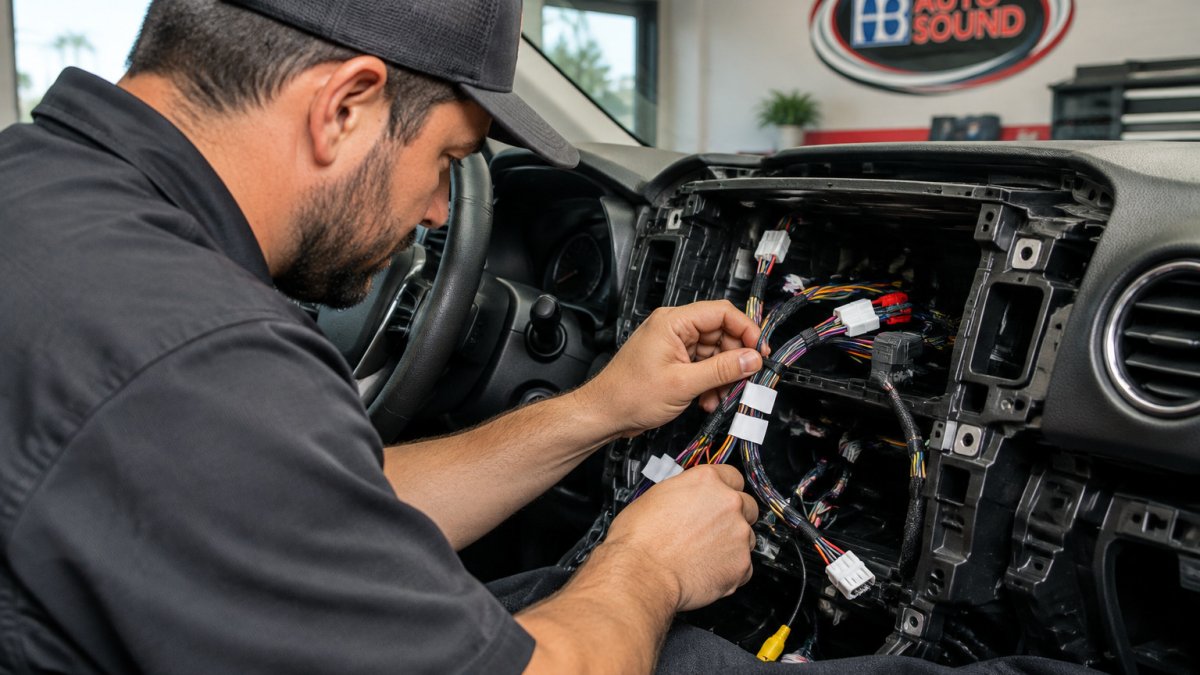
The mechanisms are not mysterious, but they are unforgiving. Power and ground must be sized to the current the amplifier will actually draw, and the ground must land on bare metal rather than a painted or corroded surface. Signal cables should be routed away from power cables to avoid induced noise. Factory connectors should be preserved with a vehicle-specific harness rather than cut, so the original radio can be reinstalled or the vehicle returned to stock. Each of these steps is invisible when done correctly and obvious when skipped.
This is where the DIY-versus-professional trade-off becomes concrete. A DIY install can save on labor, and for a simple head unit swap in an older vehicle with a straightforward harness, a careful owner can do it well. The calculus changes as the system grows. Adding an amplifier, a subwoofer, and a DSP means running new power wire through the firewall, finding a clean ground, setting gain and crossover points, and tuning time alignment, steps where a small error produces either poor sound or a safety issue.
Warranty is the other half of the trade-off. Manufacturer warranties on head units, speakers, and amplifiers cover product defects. Ask about the installation work itself before the project begins, so you know what is covered if a connection fails during the install.
Watch out: an install done with cut and twisted wires is hard to diagnose later, and intermittent static or power loss weeks after a DIY attempt is usually a connection problem, not a failed component. If you are already dealing with these symptoms, learn how electrical issues after a stereo install are diagnosed and fixed. Have a specialist check the wiring before replacing expensive parts.
Our technicians aim to route wiring cleanly, use proper harnesses, and tune the system so the speakers, amplifier, and head unit work together as one. That final tuning step is what makes a well-chosen system sound like the sum of its parts instead of a collection of expensive components fighting each other.
Keeping Steering Wheel Controls, Backup Cameras and Factory Features
Most modern vehicles route far more than audio through the factory radio harness. Steering wheel buttons, the backup camera feed, climate status displays, warning chimes, USB ports, and even some driver-assist alerts can depend on the head unit being present and communicating on the vehicle's data bus. Replacing that unit without the right interface is the single most common reason an upgrade feels like a downgrade.
The mechanism is a vehicle-specific interface module. It sits between the new head unit and the factory wiring, translates data-bus messages into signals the new radio understands, and preserves the features you want to keep. There are three broad types. A basic steering wheel control adapter handles only the buttons on the wheel. A full integration module adds retained accessory power, reverse camera input, climate display pass-through, and warning chime retention. A premium module may also preserve factory amplifier turn-on, parking sensor audio, and certain vehicle settings menus. The right one depends on year, trim, and which factory system the vehicle left the line with.
Backup cameras are their own consideration. Many factory cameras output a proprietary signal rather than a standard composite video feed, so a new head unit may need a camera retention adapter or, in some cases, a replacement camera that matches the new screen's input. If the vehicle has a 360-degree camera system or a camera integrated into the rearview mirror, the integration path is different again and should be confirmed before any parts are ordered.
Watch out: a head unit that "fits" the dash opening can still disable the factory amplifier, mute the chimes, or blank the climate display if the interface module is the wrong one for that trim. Confirm feature retention in writing before the install begins, not after.
A practical way to plan this is to list every factory feature you use in a normal week, wheel buttons, camera, USB, satellite radio, voice assistant, and have the specialist confirm each one against the proposed parts list. Features you never use can be dropped to simplify the build and reduce cost. Features you rely on should be treated as non-negotiable requirements, not afterthoughts.
Car Audio Upgrade Packages: Building a System That Works Together
Buying parts one at a time often leads to mismatched components. A better approach is to plan a package: head unit, speakers, amplifier, subwoofer and enclosure, chosen to work as a set. Matching impedance, power ratings and signal levels prevents distortion and protects your equipment. Our vehicle audio specialists build these packages around your vehicle and goals, and our car audio installation team handles the work.
Pricing depends on the components selected, the vehicle, the complexity of the install and any custom fabrication. Contact HB Auto Sound OC for a quote tailored to your car and goals. Financing options are available.
Booking Your Consultation at HB Auto Sound OC
If you are weighing an upgrade, the fastest way to get a clear answer is a consultation. Bring your vehicle and tell us what you use it for, what you want to keep working, and what you want the system to do. We will recommend components from the good, better or best tier that fit that picture, based on your listening habits and our experience with select lines.
Our team at HB Auto Sound OC works on cars, boats and RVs across Orange County. Tell us your priorities and we will help you choose the right upgrade path.
Frequently Asked Questions
What is the best aftermarket head unit for my car?
The right head unit depends on your vehicle and how you use it. A specialist will check whether your factory system ties into steering wheel controls, backup cameras or climate displays before recommending a unit. For drivers who mainly want smartphone navigation and music, a mid-range unit with wireless CarPlay or Android Auto often delivers the most value. Serious listeners may prefer a higher-end receiver with better digital signal processing. Visit HB Auto Sound OC or contact the team for a recommendation based on your vehicle and listening habits.
How much does it cost to get car audio installed?
Installation cost depends on the vehicle, the components chosen, the amount of wiring and fabrication involved, and the scope of the project. Simple head unit swaps are generally less involved than full custom builds with enclosures and amplifier wiring. Because every project is different, the best way to get accurate pricing is to contact HB Auto Sound OC for a quote tailored to your car and goals. Financing options are also available to help spread the cost.
Why use a specialist instead of installing car audio myself?
A specialist brings experience with vehicle-specific wiring harnesses, trim removal and factory integration, which helps avoid electrical problems, rattles and lost vehicle features. Professional installers also tune the system so speakers, amplifiers and subwoofers work together. Many people who attempt a DIY installation end up paying to correct wiring errors or replacing parts that were damaged during the job. A consultation can help you decide which tasks make sense to handle yourself and which are better left to a professional.
Does HB Auto Sound OC work on boats and RVs as well as cars?
Yes. HB Auto Sound OC provides audio installation and vehicle enhancement services for cars, boats and RVs in Orange County. Marine and RV environments have different requirements for moisture, vibration and power, so components and mounting methods need to be chosen accordingly. Contact the team to discuss your specific vehicle and the type of system you want.

Ready to Upgrade Your Ride?
Call us at (714) 842-1250 or visit us at 16732 Beach Blvd Ste A, Huntington Beach.
Get a Free Quote