
5 Custom Subwoofer Box Options for Your Truck
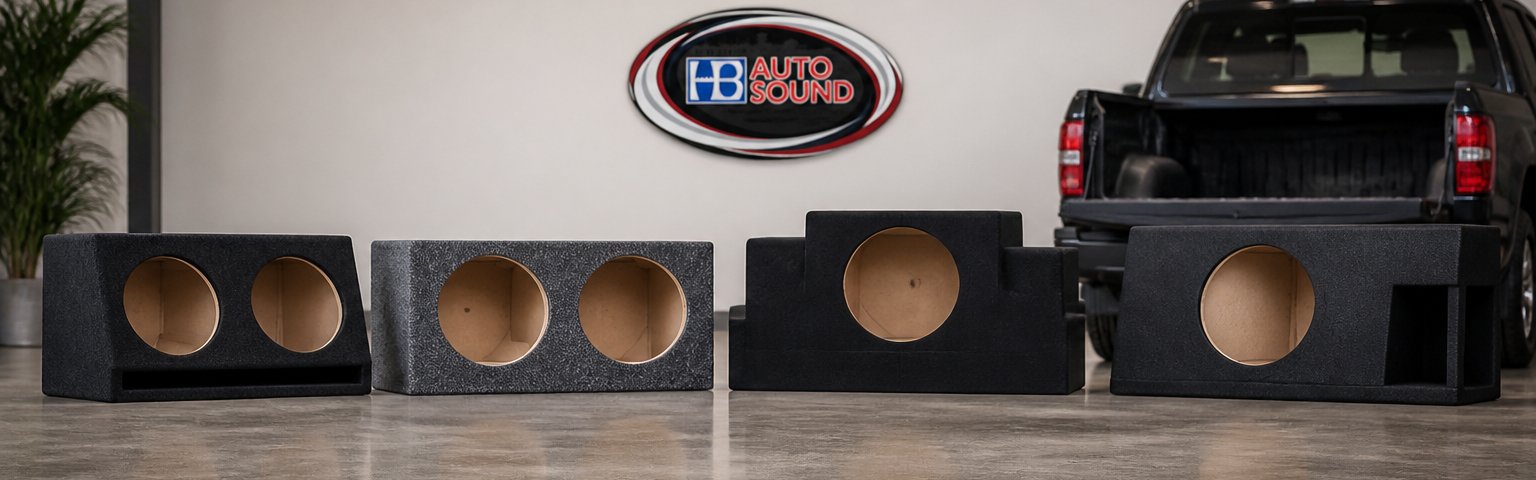
Last Updated: October 26, 2026
Quick Summary
A custom subwoofer box truck solution uses your available space intelligently, delivering bass tuned to your cab, subwoofer, and listening preferences. Unlike off-the-shelf enclosures built around generic dimensions, a vehicle-specific enclosure controls how sound travels through your cab and matches enclosure design to the truck's actual dimensions and your goals.
- Sealed enclosures are smaller and more forgiving of volume errors; ported boxes are 30 to 50 percent larger but more efficient and louder per watt.
- Under-seat boxes typically house 8-inch or 10-inch shallow-mount subwoofers and require precise fitment around seat rails and clearance constraints.
- MDF is the industry standard for affordability and clean machining; birch plywood costs more but resists moisture and warping better over years of temperature swings.
- Professional builders measure your space, design around your subwoofer's specifications, and use CNC equipment or careful hand tools to maintain tolerances during fabrication.
Table of Contents
- Why a Custom Subwoofer Box Matters for Truck Audio
- DIY Subwoofer Box Plans and Design Tools
- Sealed vs. Ported Subwoofer Box: Which Works Best in a Truck
- Truck Under-Seat Subwoofer Box Solutions
- Custom Subwoofer Box Design: Materials and Build Methods
- Professional Custom Builds vs. Off-the-Shelf Enclosures
- Getting Your Custom Subwoofer Box Built Right
- Frequently Asked Questions
Why a Custom Subwoofer Box Matters for Truck Audio
A custom subwoofer box for truck audio isn't just an upgrade, it's the foundation of sound that fits your vehicle.
Factory truck cabins weren't designed for serious audio, they're cramped, reflective, and full of competing noises. A vehicle-specific enclosure controls how sound travels through your cab and how your subwoofer performs.
Precision is what makes a custom approach work. Your truck's cab style, model year, and available space are unique, and an enclosure built around those specifics delivers bass that feels natural, not forced or boomy.
DIY Subwoofer Box Plans and Design Tools
Building your own custom subwoofer box for truck use is possible, but the difference between a box that sounds great and one that rattles, chuffs, or doesn't fit comes down to planning before you cut. Most DIY failures are planning mistakes, not cutting mistakes.
The Fitment Verification Checklist
Before you trust any plan or calculator output, verify these measurements in your actual truck with the seats in their normal driving position:
- Usable width between the seat rails, door jambs, or bed walls, not the widest point, the narrowest obstruction.
- Usable depth from the front of the mounting area to the first obstruction (seat back, cab wall, tailgate).
- Usable height from the mounting surface to the underside of the seat cushion or tonneau cover, minus at least 0.5 inch for seat travel and frame flex.
- Subwoofer mounting depth plus at least 0.75 inch of rear clearance for motor structure and voice-coil venting. A shallow-mount 10-inch sub often needs 3.5 to 4.5 inches of mounting depth; a standard-depth 12-inch can need 6 inches or more.
- Displacement of the subwoofer itself, the volume the driver and motor occupy inside the box, typically 0.05 to 0.15 cubic feet depending on size. Subtract this from gross volume to get net internal air volume.
- Port clearance if going ported: the port needs unobstructed breathing room equal to at least its diameter on the exit side, or it will chuff and lose output.
- Seat fold and cargo clearance, confirm the seat still latches, folds, and slides through its full range with the box installed.
Write every number down. If any measurement is within 0.25 inch of your plan's requirement, redesign rather than hope.
Design Tools and What They Actually Tell You
Free calculators are useful for modeling enclosure volume, port length, and tuning frequency, and the American Bass subwoofer box calculator is a reasonable starting point for exploring how volume and tuning shift bass response. What calculators don't tell you is whether the resulting box fits your truck, whether your subwoofer's Thiele-Small parameters suit the alignment, or whether your amplifier has the power to drive the design.
A few specification terms are worth understanding before you compare any two designs:
- Net internal air volume (cubic feet) is the space the subwoofer actually sees after subtracting driver displacement, bracing, and port volume. Two boxes with the same exterior dimensions can have very different net volumes.
- Tuning frequency (Hz) applies to ported boxes and determines where the port reinforces output. A box tuned in the low 30s Hz range tends to favor deep, musical bass; tuning in the 40s Hz range favors output and impact at the expense of low-end extension.
- Impedance compatibility, your subwoofer's final impedance (often 1, 2, or 4 ohms depending on voice-coil wiring) must fall within your amplifier's stable range. A dual 4-ohm sub wired in parallel presents 2 ohms; wired in series it presents 8 ohms. Mismatches cost power or damage equipment.
- Power handling is the subwoofer's thermal limit, not a target. Matching amplifier RMS output to the sub's RMS rating, rather than its peak rating, is the safer approach.
When DIY Stops Making Sense
DIY pays off when you have the tools (table saw or track saw, router, jigsaw, clamps, and a way to cut accurate circles), the space, and the patience for a multi-day build. It stops making sense when your truck's space is unusually tight, when you're running a high-power subwoofer that demands precise bracing and sealing, or when the finish needs to match a factory interior. If you're weighing the route, explore alternative custom subwoofer enclosure building methods to see how professional fabrication compares.
Sealed vs. Ported Subwoofer Box: Which Works Best in a Truck
The sealed-versus-ported decision shapes your entire bass character, and in a truck it's constrained by space in ways a sedan or SUV isn't.
How Each Type Behaves
Sealed enclosures trap air behind the subwoofer, and that air acts as a spring controlling cone motion. The result is tight, fast, accurate bass with a gentle roll-off below the sub's natural resonance. Sealed boxes are smaller, more forgiving of minor volume errors, and easier to fit into tight spaces.
Ported enclosures use a tuned vent to reinforce output near the tuning frequency, making them more efficient, louder per watt, with stronger low-end impact.
Matching the Enclosure to Your Truck and Subwoofer
Three variables should drive the decision:
- Available net volume. Measure your usable space first, then compare it to the subwoofer manufacturer's recommended sealed and ported volumes. If your space only supports the sealed recommendation, the decision is made for you. Under-seat spaces in regular and extended cabs frequently fall into this category.
- Subwoofer specifications. Every subwoofer has Thiele-Small parameters, and the manufacturer publishes recommended alignments. A sub with a high Qts (roughly above 0.5) generally favors sealed; a lower Qts sub is a better candidate for ported. Ignoring the manufacturer's recommendation is the most common cause of disappointing bass.
- Listening preference and music. If you value precision, acoustic music, and tight kick-drum reproduction, sealed is usually the better fit. If you want maximum output and felt impact for hip-hop, electronic, or bass-heavy genres, ported delivers more per watt.
Truck-Specific Trade-Offs
Cab style changes the calculus. Regular and extended cabs often have limited under-seat or behind-seat volume, pushing toward sealed or shallow-mount solutions. Crew cabs and trucks with bed space can accommodate ported boxes, but port placement matters, a port firing into a seat back or cab wall will choke output.
A practical middle path many truck owners choose is a sealed box with an efficient subwoofer paired with adequate amplifier power, it preserves space and accuracy while still delivering satisfying output. The right answer depends on your specific truck, subwoofer, and goals, which is exactly the kind of recommendation a specialist can make. Learn how to choose the right car subwoofer for your vehicle to explore enclosure types, power matching, and how to pair the perfect subwoofer with your custom truck box.
Each enclosure type offers distinct advantages and trade-offs suited to different truck spaces and listening preferences.
| Enclosure Type | Bass Character | Size vs. Sealed | Best For |
|---|---|---|---|
| Sealed | Tight, fast, accurate with gentle roll-off | Smaller, more forgiving | Precision and acoustic music |
| Ported | Stronger impact, more efficient output | 30 to 50 percent larger | Maximum output and bass-heavy genres |
Truck Under-Seat Subwoofer Box Solutions
Under-seat mounting is the practical choice for trucks where bed space isn't available or you want the subwoofer closer to your listening position.
The challenge with under-seat boxes is space.
Vehicle-specific fitment matters here more than anywhere else.
The advantage of under-seat placement is proximity: bass reaches your ears faster, and the subwoofer integrates more naturally with your front speakers.
Custom Subwoofer Box Design: Materials and Build Methods
The materials you choose determine how your custom subwoofer box truck enclosure performs and how long it lasts. Two materials dominate professional and DIY builds: MDF and birch plywood.
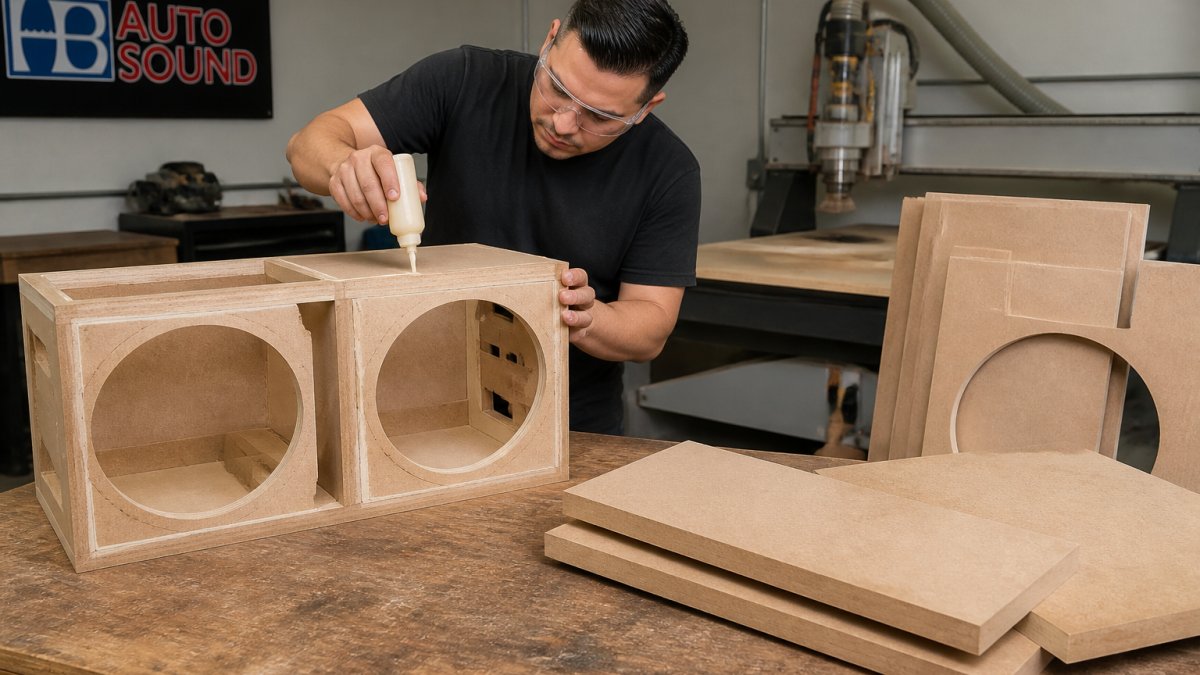
MDF and Birch Enclosure Materials
MDF (Medium-Density Fiberboard) is the industry standard for subwoofer enclosures. It's affordable, machines cleanly, accepts finishes well, and its density damps vibration to reduce unwanted resonances.
Birch plywood costs more but offers superior durability.
Wall thickness typically runs 0.75 inches for both materials. Internal bracing, wooden supports running inside the enclosure, prevents panel resonance and maintains structural integrity under subwoofer pressure.
Carpet and Bedliner Finishes
How you finish your enclosure affects both appearance and function. Two finishes dominate truck installations: carpet and bedliner.
Carpet finish matches truck interiors and looks professional.
Bedliner finish uses spray-on polyurethane or rubber coating designed for truck beds. It's durable, moisture-resistant, and matches factory truck protection.
Your choice depends on truck style and personal preference: carpet interiors usually favor carpet-finished enclosures, while exposed bed liners or utilitarian interiors suit bedliner finishes.
Professional Custom Builds vs. Off-the-Shelf Enclosures
The core trade-off is precision versus convenience. Off-the-shelf enclosures are ready to install and cost less upfront.
Off-the-shelf enclosures work for general applications. Manufacturers design them for common vehicles and typical usage, so you get a tested design, predictable performance, and fast installation.
Custom builds start with your truck's actual dimensions and your performance goals.
Custom builds cost more and take longer, but they eliminate compromise.
Getting Your Custom Subwoofer Box Built Right
Professional fabrication ensures your custom subwoofer box truck enclosure is built to specification, finished cleanly, and installed properly.
Start with a detailed consultation.
Next comes design. The builder creates a blueprint or 3D view showing dimensions, internal bracing, port specifications, and finish details.
Fabrication demands precision: panels cut to exact dimensions, accurately routed ports, internal bracing, and every joint sealed.
Installation is final.
HB Auto Sound OC handles this entire process with certified installers who specialize in custom fabrication. Learn what happens during professional car audio installation to understand how the process protects your investment and ensures quality.
A custom subwoofer box for truck audio transforms how your system sounds. The right enclosure delivers bass that sounds natural in your cab, integrates with your other speakers, and stays reliable for years. Get a free quote from HB Auto Sound OC to explore custom fabrication options for your truck, or discuss how our certified installers can build the enclosure that fits your vehicle and your sound goals.
Frequently Asked Questions
Should I build a sealed or ported subwoofer box for my truck?
Sealed enclosures deliver tight, accurate bass and work well in smaller spaces, ideal for under-seat truck installations. Ported boxes produce louder, deeper bass but require more room. Your choice depends on available space in your truck cab, your sound preferences, and whether you prioritize accuracy or output. A professional installer can recommend the best sealed vs. ported approach based on your vehicle and listening goals.
How do I measure my truck for an under-seat subwoofer box?
Measure the width, depth, and height of the space under your seats, accounting for existing wiring and components. Check clearance with seats in all positions and note any obstructions like fuel tanks or exhaust. Document your truck's cab style and model year. These measurements ensure a custom subwoofer box design fits perfectly without interfering with comfort or safety. Professional fabricators use these specs to create a box that maximizes bass performance in your specific truck.
Can I use a vehicle-specific subwoofer enclosure with different subwoofers?
Some vehicle-specific enclosures are designed for a particular subwoofer model and may not work well with others due to differences in mounting depth, impedance, and tuning. A custom subwoofer box design tailored to your chosen subwoofer ensures proper fitment, impedance matching, and optimal sound quality. If you plan to swap subwoofers later, discuss compatibility with your fabricator before building.
Is it cheaper to build your own subwoofer box?
DIY builds save on labor, but you'll invest in materials, tools, and time, plus the learning curve can lead to design mistakes that affect sound quality. Professional custom subwoofer box fabrication ensures proper internal air volume, port tuning, and structural integrity. The difference often comes down to your skill level, available tools, and how critical sound performance is to you. Many truck owners find professional builds worth the investment for reliability and performance.

Ready to Upgrade Your Ride?
Call us at (714) 842-1250 or visit us at 16732 Beach Blvd Ste A, Huntington Beach.
Get a Free Quote